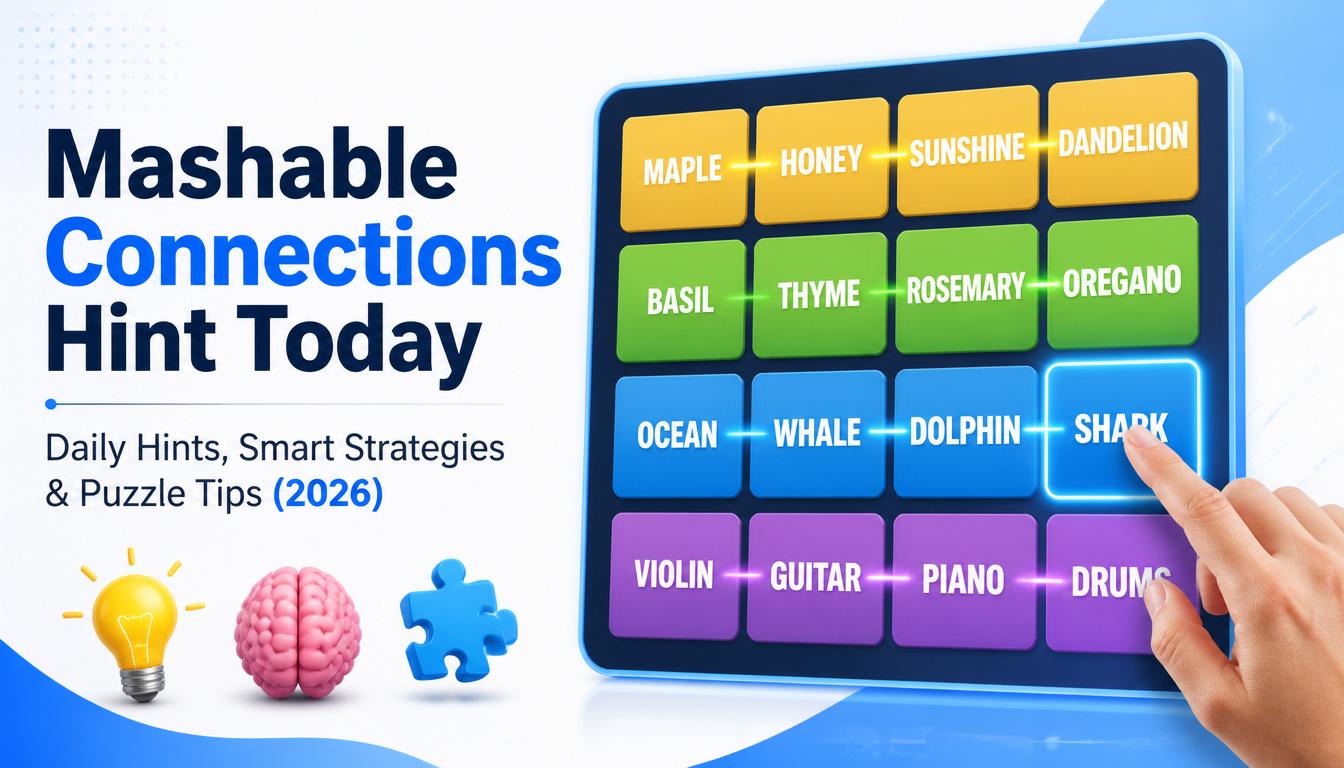
Every morning, thousands of word game fans open NYT Connections believing today’s puzzle will be easier than yesterday’s. A few minutes later, they’re staring at sixteen words that seem to fit together in countless different ways. Four words look like animals, then suddenly one turns out to belong to a movie title. Another appears to be a color but is actually part of a famous phrase. That’s exactly what makes the game so addictive.
If you’ve searched for Mashable Connections Hint Today, you’re in good company. Players don’t always want the complete answers they simply want a gentle push in the right direction. A well-written hint keeps the challenge alive while helping you avoid frustrating dead ends. Instead of spoiling the puzzle, it encourages you to think differently, notice hidden patterns, and solve the categories on your own.
Unlike crossword puzzles that test definitions or spelling, NYT Connections rewards observation, flexible thinking, and the ability to recognize relationships between seemingly unrelated words. One day you may group planets, while the next day you’re identifying famous movie villains, keyboard shortcuts, or words that sound alike. Every puzzle feels fresh because the categories constantly change.
This guide explains everything you need to know about Mashable Connections Hint Today, including how the puzzle works, why so many players rely on daily hints, and the techniques that consistently help beginners and experienced players solve Connections faster. Whether you’re trying to protect a winning streak or simply improve your puzzle-solving skills, the strategies below will help you approach every game with greater confidence.
What Is NYT Connections?
NYT Connections is one of the most popular daily word games published by The New York Times. The objective looks surprisingly simple.
You’re given 16 words arranged in a four-by-four grid.
Your mission is to sort those words into four separate groups, with each group containing four words connected by a common theme.
Some categories are straightforward.
Others are brilliantly deceptive.
You might be looking for:
- Countries
- Sports
- Musical instruments
- Flowers
- Computer terms
- Kitchen items
- Movie franchises
- Internet slang
- Famous people
- Science terms
The challenge isn’t knowing what each word means.
The real challenge is figuring out which meaning the puzzle creator intended.
A single word can belong to several different categories, and that’s exactly where Connections becomes both clever and addictive.
Unlike many traditional word games, there isn’t one obvious path toward the solution. Every puzzle encourages players to slow down, analyze possibilities, and think beyond the first answer that comes to mind.
Why Mashable Connections Hint Today Is So Popular
The popularity of Mashable Connections Hint Today isn’t difficult to understand.
Most players enjoy solving puzzles themselves.
What they don’t enjoy is becoming completely stuck after making two or three incorrect guesses.
That’s where daily hints become valuable.
Instead of revealing every category immediately, good hint guides provide just enough information to help players think differently.
For example, instead of saying:
Category: Fruits
A hint might simply say:
“Think about common foods found in a grocery store.”
That tiny clue is often enough to restart your thinking without ruining the satisfaction of solving the puzzle yourself.
Another reason these daily hints attract millions of readers is that they preserve the excitement of the game.
People don’t want spoilers.
They want confidence.
A carefully written hint gives players one more chance to find the solution on their own.
That balance between guidance and challenge explains why Mashable Connections Hint Today has become part of many players’ daily routine.
See More: Do the Driving Modes in Cadillac Lyriq Offer Different Ranges or Battery Usages Guide
How NYT Connections Puzzle Works
Although Connections looks simple at first glance, every puzzle is carefully designed to test pattern recognition rather than vocabulary alone.
You begin with sixteen words.
Your goal is to organize them into four meaningful categories.
Each correct category removes four words from the board.
If your selection isn’t correct, you lose one mistake.
The game allows only four mistakes, so every guess matters.
Many players make the mistake of clicking as soon as they notice four similar words.
Experienced players rarely do that.
Instead, they pause and ask themselves:
“Could any of these words belong somewhere else?”
That one question prevents many unnecessary mistakes.
Successful Connections players spend far more time observing than guessing.
Difficulty Colors
Each completed category belongs to one of four difficulty levels.
| Color | Difficulty | What It Usually Means |
|---|---|---|
| Yellow | Easy | The relationship is usually obvious and easy to identify. |
| Green | Medium | Requires slightly more thought but remains fairly clear. |
| Blue | Hard | Categories become less obvious and often require broader knowledge. |
| Purple | Very Hard | Frequently includes puns, hidden meanings, wordplay, abbreviations, or unexpected relationships. |
Purple categories are famous for surprising even experienced players.
Sometimes every word appears unrelated until you notice one tiny detail connecting them all.
That “aha!” moment is one of the biggest reasons people return every day.
Why You Get Stuck in Connections
Even experienced players occasionally struggle with puzzles that seem impossible at first.
The good news is that getting stuck usually happens for predictable reasons.
Once you understand those reasons, you’ll start recognizing them much earlier.
1. Multiple Meanings
Many English words have more than one meaning.
Take the word Mercury.
It could represent:
- A planet
- A chemical element
- A Roman god
- A historic automobile brand
If you immediately assume only one meaning, you may overlook the correct category entirely.
Connections constantly challenges players to think beyond the most obvious definition.
2. Fake Group Patterns
This is probably the puzzle’s favorite trick.
Four words appear to belong together perfectly.
You confidently select them.
Wrong.
The puzzle intentionally creates convincing false groups that tempt players into making mistakes.
For example, four words might all seem related to sports, yet one secretly belongs to a completely different category involving famous brands or movie titles.
Recognizing these distractions takes practice, patience, and careful observation.
3. Overthinking Simple Answers
Ironically, many players fail because they expect every category to be incredibly clever.
Sometimes the answer really is as simple as:
- Months
- Colors
- Fruits
- Animals
- Countries
When players search for hidden meanings everywhere, they often ignore the obvious solution sitting right in front of them.
A good rule is simple:
If a category fits naturally, don’t reject it simply because it seems too easy.
4. Early Guessing Errors
Connections rewards careful thinking far more than quick reactions.
Many beginners click the first four words that appear related.
Experienced players rarely rush.
Instead, they compare several possible categories before making their first selection.
That extra minute of analysis often saves multiple mistakes later in the puzzle.
One careful decision at the beginning can completely change the outcome of the game.
What Makes Mashable Connections Guide Useful
One reason players continue searching for Mashable Connections Hint Today is that the format respects the experience of solving the puzzle.
Rather than immediately revealing every answer, the guide usually follows a step-by-step approach.
It begins with gentle clues.
Then it offers category hints.
Only after that does it reveal the complete solution.
This layered approach allows players to stop reading as soon as they’ve received enough help.
For many people, that’s the perfect balance. They still enjoy the satisfaction of solving the puzzle themselves while avoiding the frustration of staring at the same sixteen words for twenty minutes without making progress.
Smart Strategy to Solve NYT Connections Faster
Winning at NYT Connections is not about having the biggest vocabulary. It is about recognizing relationships between words and avoiding the traps hidden inside almost every puzzle. If you build a consistent approach, you’ll notice that even the harder purple categories become much easier over time.
Start With Obvious Groups
The fastest way to make progress is by identifying the most obvious connections first. Look for words that clearly belong together, such as countries, sports, animals, colors, musical instruments, or months of the year.
Once you remove an easy group, the remaining words become easier to analyze because there are fewer possible combinations.
For example, if you immediately spot four fruit names, submit that group before exploring more difficult possibilities. Eliminating obvious answers reduces clutter and helps reveal hidden patterns among the remaining words.
Focus on Category Thinking
Many beginners focus only on individual words. Experienced players think about categories instead.
Instead of asking, “What does this word mean?” ask yourself, “What category could these four words belong to?”
A single word can fit multiple categories. That’s why looking at the entire group is much more effective than analyzing each word in isolation.
Some common Connections categories include:
- Movie genres
- Famous landmarks
- Kitchen tools
- Computer terms
- Weather conditions
- Musical artists
- Board games
- Card suits
- Programming languages
- Types of transportation
Training yourself to think in categories dramatically improves your success rate.
Use the Elimination Method
Sometimes the best strategy is removing what you already know.
Imagine you’ve confidently solved two categories. Only eight words remain.
Instead of guessing randomly, compare every remaining word with every other one. You’ll often notice patterns that were hidden earlier because the original grid contained too many distractions.
Professional puzzle solvers regularly use elimination because it reduces mistakes and improves accuracy.
When in doubt, slow down rather than submit a risky guess.
Watch for Trap Words
Every daily puzzle contains misleading words designed to tempt players into incorrect groups.
For example, you may see four words that all relate to sports at first glance. After a closer look, only three belong together, while the fourth actually fits a completely different category.
These “trap words” are one of the biggest reasons players search for Mashable Connections Hint Today before using all four mistakes.
Some common traps include:
- Words with multiple meanings
- Similar spellings
- Related themes that are not actual categories
- Famous names sharing different professions
- Colors that are also surnames
- Objects that are also verbs
Recognizing these patterns comes with experience.
Think in Patterns, Not Words
Connections rewards pattern recognition more than vocabulary.
Instead of reading words one by one, scan the board for relationships.
Ask yourself questions like:
- Do these words belong to the same profession?
- Are they all movie titles?
- Could they be famous brands?
- Do they share the same prefix or suffix?
- Are they connected by geography?
- Could they all describe the same activity?
The more patterns you recognize, the faster you’ll solve future puzzles.
Example Breakdown (How Solving Works)
Understanding the solving process is often more valuable than simply reading the final answers. Here’s a simple example of how experienced players work through a Connections puzzle.
Step 1: Planets
Suppose you notice the words:
- Mars
- Venus
- Jupiter
- Saturn
These clearly belong together as planets.
Since the relationship is obvious, you should submit this group first instead of searching for more complicated connections.
Step 2: Metals
After removing the planets, you notice another set:
- Gold
- Silver
- Copper
- Iron
Again, these share a strong relationship.
Finding straightforward categories early makes the rest of the puzzle much less intimidating.
Step 3: Fruits
The remaining words include:
- Apple
- Banana
- Mango
- Orange
Although these seem simple, always double-check before submitting. Sometimes one word belongs elsewhere, and the puzzle intentionally encourages quick mistakes.
A careful second look can save one of your four guesses.
Step 4: Water Bodies
Finally, the last four words are:
- Ocean
- Lake
- River
- Sea
Since every previous category has already been confirmed, this final group completes the puzzle.
This example demonstrates an important lesson: successful players solve the puzzle through logical elimination rather than random guessing.
Why Daily Practice Matters
Many players assume Connections depends entirely on intelligence. In reality, consistent practice often matters more than natural ability.
The more daily puzzles you complete, the more familiar you become with recurring category styles, common tricks, and hidden relationships. Over time, your brain begins to recognize patterns almost automatically.
Daily practice also helps expand your vocabulary in a practical way. Instead of memorizing definitions, you learn how words relate to one another across different themes such as geography, entertainment, science, food, history, sports, and popular culture.
Even spending five to ten minutes each day can noticeably improve your solving speed after a few weeks.
For regular players, Mashable Connections Hint Today becomes less about finding answers and more about learning new ways to think through challenging puzzles.

I’m a professional blog writer with over 10 years of experience in crafting engaging and original content, particularly in the blessings and quotes niche. My focus is on delivering high-quality, reader-friendly, and well-researched content that both inspires and adds meaningful value to readers.
Through blessingpress.info, I consistently create and share unique content aimed at building trust, strengthening authority, and connecting with a loyal and growing audience.